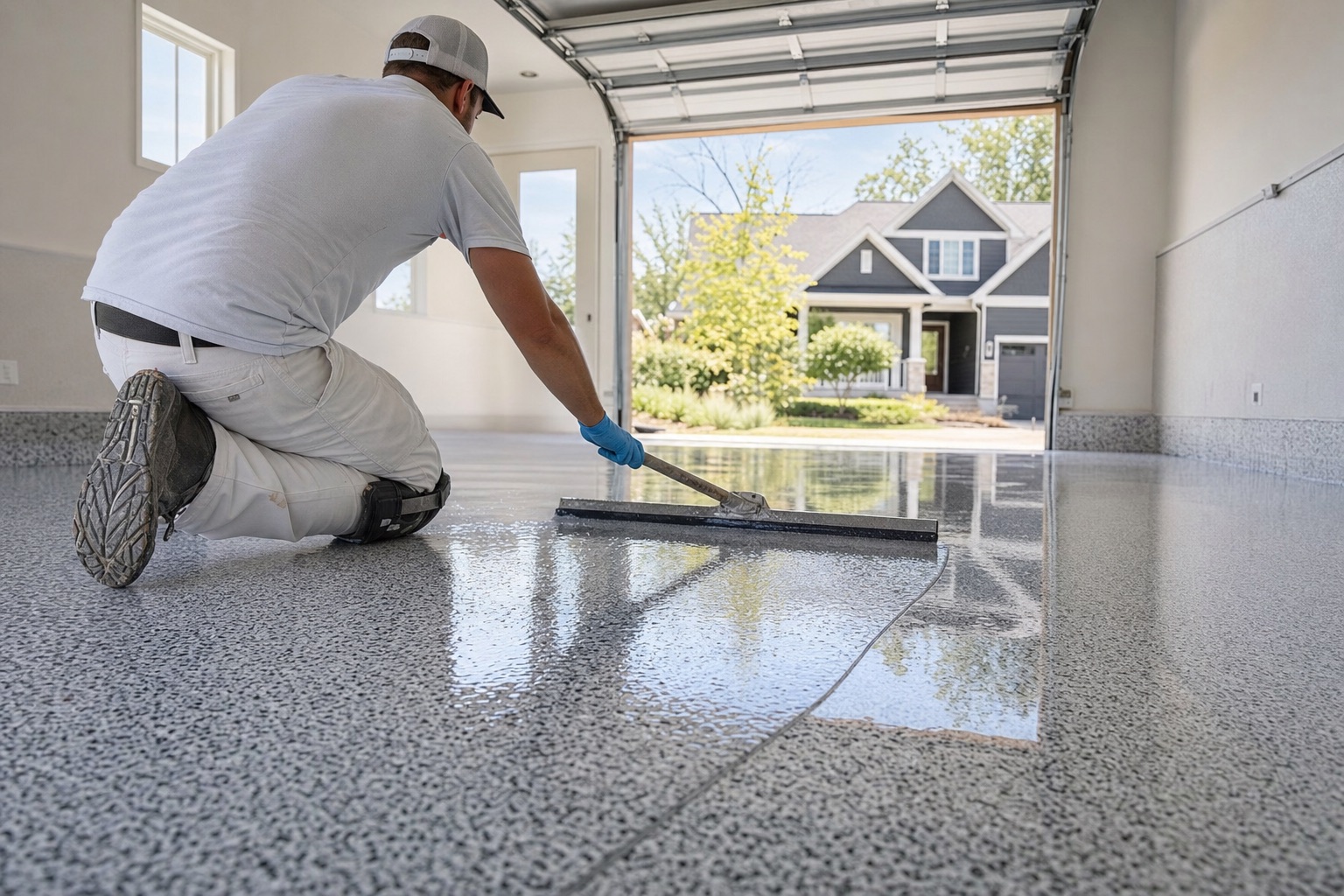
Fixing Garage Floor Salt Damage With a Flake or Polyaspartic Coating
Road salt brine soaks into bare garage concrete and freeze-thaw breaks up the surface. Here is how grinding, repair and a flake epoxy or polyaspartic coating fix it.
Honest quote in about 24 hours. No pressure.
Local crew · Diamond-grind prep · Workmanship warranty
Garage floor salt damage happens when road salt brine drips off your car, soaks into bare concrete, and freezes and thaws inside the surface all winter. It leaves pitting, flaking and white salt stains in the tire lanes and near the door. The fix is to diamond grind off the salt-loaded top layer, moisture test the slab, fill the pits and spalls, and install a flake epoxy or polyaspartic coating so brine sits on top instead of soaking in.
Updated October 2026How does road salt get into a garage floor?
After a snow in Naperville, Aurora or Plainfield, your car carries the road into the garage. Village plows and IDOT trucks on Route 59, Ogden Avenue and I-88 spread salt all winter. It mixes with slush, packs into the wheel wells, and melts off once the garage is warmer than outside.
That melt is brine, not plain water. It pools under the car, runs toward the low spots and the door, and sits there.
Bare concrete is porous, so brine soaks into the top of the slab. When the water evaporates, the salt stays in the pores. Every storm adds more. By spring the top layer of the floor is loaded with salt, and that layer is exactly what a coating would have to bond to.
The takeaway: Salt damage starts in the top layer of bare concrete, and that is the layer a coating has to grip.
Why does freeze-thaw make salt damage worse?
Most attached garages in the western suburbs are not heated. On cold nights the slab drops below freezing. On sunny days, or under a warm car, it thaws. That can happen many times in one Illinois winter.
Water expands when it freezes. When the pores near the surface hold brine and it freezes, the ice pushes on the concrete from inside. Salt keeps the surface wet longer, so more water is in the pores at the next freeze. Some de-icers, calcium chloride in particular, can also react with the cement paste and weaken it.
The damage starts at the top and works down a little each cycle. That matters for a coating. The surface you see is weak, salty and often damp, and none of those bond well.
The takeaway: Each freeze-thaw cycle weakens the surface a little more, so the damaged layer has to come off before anything goes on.
What does garage floor salt damage look like?
Pull the cars out on a dry day and check the tire lanes, the area by the door, and the edge of the apron. Here is what to look for and what each sign means for prep.
- White staining. A chalky haze or crusty rings where puddles dried. This is salt in and on the surface. It often comes back after washing because more salt works up from inside. It has to be ground off, not just scrubbed, before a coating goes down.
- Pitting. Small craters scattered in the tire lanes. Pits are filled after grinding so the coating lies flat and has no low spots to hold water.
- Spalling or scaling. Thin patches of surface flaking off, often worst near the door. Loose concrete is ground back to a sound surface, then the low areas are rebuilt.
- Exposed stone. The top paste is gone and you can see the gravel. This floor needs more repair before coating, and it is a sign not to leave it bare another winter.
- Dark, damp lanes. Areas that stay darker because salt pulls moisture into the concrete. This is one reason we moisture test before coating.
Oil often soaks into the same weakened areas. Salt and oil both need to come out before anything is applied.
The takeaway: Every visible sign of salt damage points to a specific prep or repair step, and none of them can be coated over as-is.
Why do sealers, floor paint and DIY kits peel on salted concrete?
Many homeowners try a sealer, floor paint or a store kit first. On a salt-damaged slab they share one problem. They go over the damaged layer instead of removing it.
- Penetrating sealers slow water down on good concrete. They wear, need reapplying, and do not fill pits or fix flaking.
- Floor paint and thin topical sealers form a thin film. Hot tires and brine lift it at the edges, and it peels off along with the weak concrete under it.
- DIY epoxy kits usually rely on acid etching. Etching does not remove salt-contaminated concrete, and coating over that layer is a common reason kits start peeling.
The fix is prep. Our post on grinding versus acid etching concrete before epoxy explains why grinding is the step that decides whether a coating holds on a salted floor.
The takeaway: Products that skip removing the salt-loaded layer tend to peel, no matter how good the product is.
How is salt-pitted concrete repaired before coating?
Every garage floor we coat starts with diamond grinding and a moisture test. On a salt-damaged slab, those steps plus repair work are what let the coating last.
1. Diamond grinding
We grind off the salt-loaded, weakened top layer, along with old paint or sealer and surface stains. This exposes sound concrete and opens it so the coating can grip.
2. Moisture test
We test the slab before anything goes down. Moisture coming up through concrete is a common reason coatings lift, and salt-soaked floors can hold more of it. The flooring industry uses standardized methods for checking slab moisture, such as the ASTM F2170 relative humidity test.
3. Pit, spall and crack repair
Pits, scaled areas and cracks are filled and ground flush. That leaves the finished floor level and closed.
4. Base coat, flake and topcoat
A base coat goes down, decorative flake is broadcast into it, and a clear topcoat seals the surface.
Once cured, the coating is one continuous surface. Brine sits on top where you can squeegee or rinse it, instead of soaking into the slab. You can see the full system on our garage floor epoxy page for Naperville homes.
The takeaway: Grinding, testing and repair are what turn a salt-damaged slab into a floor a coating can hold onto.
Flake epoxy vs. polyaspartic: which holds up better to road salt?
Both systems hold up to salt once cured over proper prep. The differences are sunlight, cure time and install temperature.
| Flake epoxy system | Polyaspartic system | |
|---|---|---|
| Salt resistance once cured | Good | Good |
| Sunlight and yellowing | Epoxy can yellow in sunlight | Typically UV stable |
| Cure speed | Slower | Typically faster, so you are back on the floor sooner |
| Cooler-weather installs | More limited | Typically more flexible |
A flake epoxy garage floor fits many attached garages. The flake hides the patched pits, so a damaged floor ends up looking even.
For a garage that faces salt every winter and gets afternoon sun through an open door, a polyaspartic garage floor coating is often the recommendation. For a wider look at the materials, see our epoxy vs. polyaspartic vs. polyurea guide. We will tell you which fits after seeing the floor.
The takeaway: Both resist salt; sun exposure, cure time and install season usually decide between them.
What should you do about salt damage before the first snow?
Each winter on bare concrete adds to the damage, and the repair grows with it. A floor that is ground, repaired and coated in October or early November goes into salt season sealed.
- Check the floor now with the cars out, looking at the tire lanes, the door area and the apron edge.
- Get it looked at early. Fall schedules fill up.
- Ask about cold-weather installs. Coatings have temperature limits for install and cure. Our post on epoxy garage floor installs during an Illinois winter covers what is possible once it gets cold.
If you can't coat before the snow, slow the damage. Squeegee brine out of the garage and rinse the floor with plain water on milder days. Put a containment mat under each car.
The takeaway: Coating in fall stops the next winter of damage; if that is not possible, keep brine off the bare slab.
What should you expect from a garage floor estimate?
We coat garage floors in Naperville, Aurora, Plainfield, Wheaton, Bolingbrook, Lisle and nearby western suburbs. On an estimate we look at the pitting, spalling and staining. We explain the grinding, moisture testing and repair your floor needs, then go over flake colors and epoxy or polyaspartic options.
What a good quote includes
- The prep method, named plainly as diamond grinding.
- A moisture test before coating.
- How pits, spalls and cracks will be repaired.
- The coating system: base coat, flake and topcoat, and whether it is epoxy or polyaspartic.
You get a clear scope so you can compare quotes on the same work. Estimates are free. Request a free garage floor estimate and we will set a time to look at the floor.
The takeaway: Compare quotes on prep and repair first, because that is where salt-damaged floors succeed or fail.
The bottom line on garage floor salt damage
Salt damage comes from brine soaking into bare concrete and freeze-thaw breaking up the surface. Sealers, paint and kits that go over the damaged layer tend to peel. Grinding, a moisture test, repair and a flake epoxy or polyaspartic coating remove the problem and close the surface. The sooner the floor is coated, the less there is to repair.
Keep Reading
FAQ
FAQ
Free, No-Pressure Estimate
Get a Free Estimate in Naperville
Seeing pitting, flaking or white stains on your garage floor? Request a free estimate and we will look at the damage and explain the prep and coating it needs.
(630) 326-6456 · Open 7 days · 8am–5pm
1750 W Ogden Ave, Naperville, IL 60540
Honest quote in about 24 hours. No pressure.
Local crew · Diamond-grind prep · Workmanship warranty