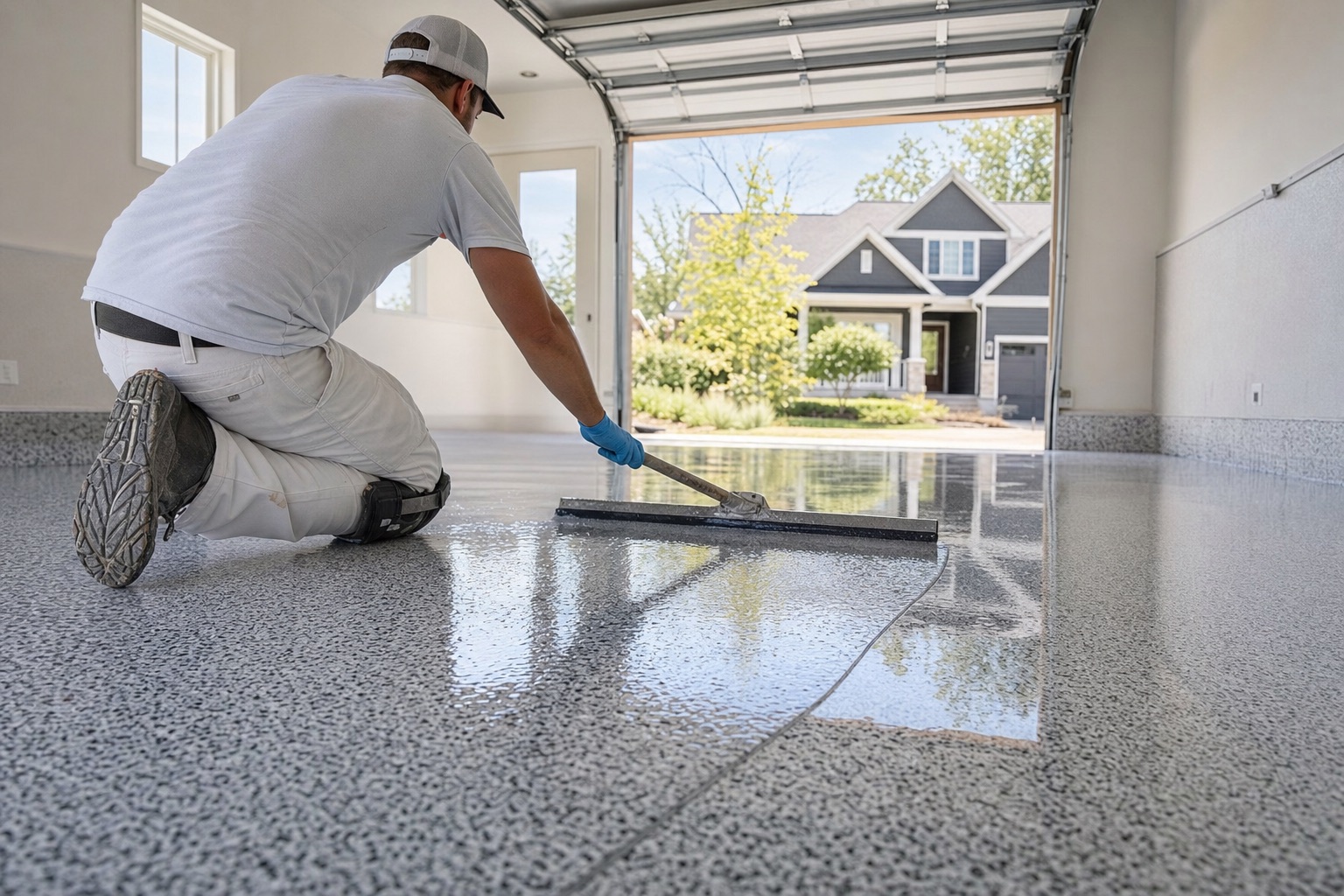
Can You Coat a Cracked or Pitted Garage Floor? Repair Before Epoxy
Most cracked, pitted and salt-damaged garage floors can be repaired and coated if the slab is solid and not moving. Here is what can be fixed, what can't, and how the repair is done before epoxy.
Honest quote in about 24 hours. No pressure.
Local crew · Diamond-grind prep · Workmanship warranty
Yes. Most cracked, pitted and salt-damaged garage floors can be repaired and coated, as long as the slab underneath is still solid and not moving. The damage is diamond ground, filled, ground flush and then coated, but slabs that have heaved, sunk, crumble throughout or push water up from below need to be fixed or replaced first.
Updated October 2026What garage floor damage can be repaired before epoxy?
A floor can look rough and still be a good candidate for a coating. What matters is whether the concrete under the damage is sound. This post covers which damage can be fixed, when a slab is too far gone, how the repair is done, and what a quote should include.
At a glance
- Usually repairable: hairline cracks, wider cracks that are not moving, pits, popouts, salt scaling, chipped control joints and stains.
- Fix or replace first: heaved or sunk sections, offset cracks, cracks that keep growing, crumbling across the floor, and water coming up from below.
- How it is done: diamond grinding, crack and pit filling, grinding patches flush, then the coating.
- Best cover for patches: a full flake system with a clear top coat.
Common damage that can be filled and coated
These are the common problems we see on garage floors that can be filled and coated:
- Hairline cracks. Thin shrinkage cracks that run across the slab. They are common on floors of any age.
- Wider cracks that are not moving. If both sides of the crack sit at the same height and the crack is not growing, it can be opened up and filled.
- Pitting and popouts. Small craters where bits of aggregate or surface paste have broken loose.
- Salt scaling and spalling. Flaking and shallow chunks missing near the garage door and under the wheel paths, where salty snowmelt drips off the car.
- Chipped control joints. The cut lines in the slab often break down at the edges over time.
- Salt and oil stains. These are not structural damage, but they need to be ground and cleaned out so the coating can bond.
All of these are surface problems. The repair fills them in and gives the coating a flat, clean surface to grip.
The takeaway: If the damage is on the surface and the slab is not moving, it can usually be repaired and coated.
When is a garage slab too far gone to coat?
A coating is a thin layer. It will follow whatever the slab does. If the concrete is moving or breaking apart, the coating will crack or lift with it.
Signs the slab needs more than a coating
- One side of a crack sits higher than the other.
- Sections of the floor have heaved up or sunk down.
- Cracks keep getting wider or new ones keep showing up.
- The surface crumbles or powders across most of the floor, not just in spots.
- Water or dampness comes up through the slab.
In these cases the slab may need leveling, structural repair or replacement first.
Why the moisture test matters
Moisture is checked with a moisture test before any coating is planned. Water pushing up from below can push a coating off. Industry test methods such as ASTM F2170 measure relative humidity inside the slab. Basement slabs are the most common place this shows up, but garages can have it too. Our guide to basement floor moisture and vapor explains how moisture affects a coating.
Be wary of anyone who says a coating will fix a slab that is moving. It will not. A good estimate tells you plainly when the concrete itself is the problem.
The takeaway: Moving, crumbling or wet slabs get fixed first, because a coating cannot hold a failing slab together.
Why does grinding find damage you can't see?
Salt damage often goes deeper than it looks. Road salt and freeze-thaw cycles weaken the top layer of the concrete. The American Concrete Institute publishes guidance on how deicing salts and freezing cause surface scaling. The surface can look intact while the paste just under it has gone soft. Old sealers, paint and failed DIY coatings can also hide pits and soft spots.
What grinding uncovers
Diamond grinding takes off that weak top layer. As it does, hidden pits open up, soft areas break loose, and old coatings come off. A floor that looked like it had a few pits can show a larger damaged area once it is ground. That is normal. It is better to find the weak material now than to coat over it and have it fail later.
Why acid etching falls short on damaged floors
Acid etching does not do the same job on a damaged floor. Acid cleans and roughens the surface, but it does not remove weak concrete or open up hidden damage. Our guide on grinding versus acid etching for concrete prep covers that comparison in more detail.
Ask any contractor you get a quote from how they handle extra repair that turns up after grinding. The answer should be clear before work starts.
The takeaway: Grinding exposes weak concrete that acid etching leaves behind, so expect the true repair area to show up during prep.
What materials are used to repair cracks and pits before coating?
How the repair is done
After grinding, each damaged area gets cleaned out and vacuumed. Cracks are usually cut open slightly with a crack-chasing blade. That gives the filler clean, solid edges to bond to. Then the right filler goes in for the type of damage.
| Damage | Typical repair |
|---|---|
| Hairline and narrow cracks | Chased open, then filled with an epoxy or polyurea crack filler |
| Pits and popouts | Filled with an epoxy or polyaspartic patch material |
| Spalled and scaled areas | Built back up with an epoxy mortar or patching compound |
| Broken control joint edges | Rebuilt with patch material, then the joint is filled or kept open |
Once the fillers cure, the patched areas are ground flush with the rest of the floor. This step matters. A patch that sits high or low will show through the finished coating.
What filler cannot fix
One honest limit: a crack that moves with seasonal changes can come back through any coating over time. Filling it makes it much less noticeable, but no filler can stop a slab from moving.
The takeaway: Each type of damage gets its own filler, and every patch is ground flush so it does not show in the finish.
Will repaired areas show through a flake or solid color floor?
Repaired areas never match the original concrete. The filler is a different color and can have a slightly different texture. Under a solid color coating, patches can show as faint outlines, especially in low-angle light from the garage door.
How a flake system covers repairs
A flake system covers that. Vinyl chips are broadcast into the base coat, and then a clear top coat seals them in. The mix of colors breaks up the surface so the eye does not pick out patches, filled cracks or old stains. The texture also helps hide small dips that remain after repair.
| Finish | How repairs look | Good fit for |
|---|---|---|
| Solid color | Patches can show as faint outlines in low-angle light | Floors that need little repair |
| Full flake broadcast | Patches, filled cracks and old stains blend into the chips | Older, cracked or pitted floors |
For older, damaged garage floors, a full flake broadcast with a polyaspartic top coat is a common choice for this reason. See how flake epoxy garage floors are built, or read more about the systems we install on our garage floor epoxy page for Naperville homes.
The takeaway: If your floor needs a lot of repair, a full flake system will hide the patches far better than a solid color.
Why are so many garage floors in the western suburbs pitted and cracked?
Older slabs and road salt
Winters here are hard on garage floors. Cars bring in snow mixed with road salt. It melts, sits on the slab, then freezes and thaws again. Over years, that wears down the surface near the door and in the wheel paths. Older homes in Naperville, Wheaton, Lisle and Bolingbrook often have floors with this kind of scaling, plus cracks from decades of settling.
Newer subdivisions
Newer subdivisions in Plainfield and Aurora have their own issues. Newer slabs can still have shrinkage cracks, rough finishing, or early salt damage after just a few winters. If you are in Aurora, see our page on epoxy flooring in Aurora.
Wider surface damage
For floors with wider surface damage, repair and resurfacing can be part of the same project. Our concrete coating and resurfacing services page explains those options. You can also look through finished floors in our project photo gallery.
The takeaway: Salt, freeze-thaw and settling cause most of the damage here, and it can show up on new slabs as well as old ones.
What should you expect from an estimate on a damaged garage floor?
Photos to take before the estimate
Photos help you get a clear answer faster. Before your estimate, take a few pictures of your floor:
- The full floor from the doorway into the house.
- Close-ups of the worst cracks, with something for scale like a coin.
- Any area where one side of a crack sits higher.
- The area near the garage door and the wheel paths.
- Any old paint or coating that is peeling.
What a good quote includes
A serious quote on a damaged floor should list the prep and repair, not just the coating. Look for these items:
- Diamond grinding of the full floor.
- A moisture test.
- Crack and pit repair, with patches ground flush.
- How added repair found during grinding will be handled.
- The coating system, such as epoxy, flake or polyaspartic.
If any of those are missing, ask. We offer free estimates across Naperville and the western suburbs. You can request a free estimate and send photos of your slab.
The takeaway: A quote that spells out grinding, moisture testing and repair is a quote you can compare fairly.
So can your cracked or pitted garage floor be coated?
If the slab is solid and not moving, almost certainly yes. Grinding removes the weak layer, fillers rebuild the cracks and pits, and a flake system hides the patches. If the slab has heaved, sunk, crumbles throughout or pushes up water, fix the concrete first and coat it after.
FAQ
FAQ
Free, No-Pressure Estimate
Get a Free Estimate in Naperville
Have a cracked or pitted garage floor? Request a free estimate and send a few photos of your slab, and we will tell you what repair it needs before any coating goes on.
(630) 326-6456 · Open 7 days · 8am–5pm
1750 W Ogden Ave, Naperville, IL 60540
Honest quote in about 24 hours. No pressure.
Local crew · Diamond-grind prep · Workmanship warranty